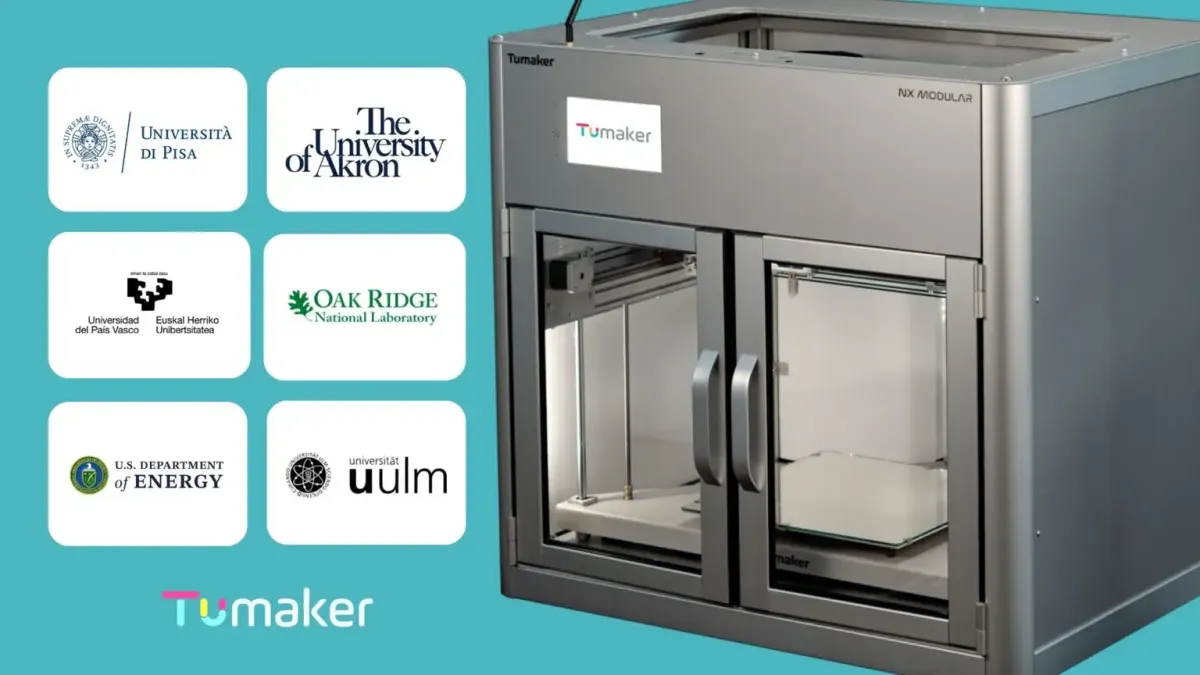
TUMAKER pellet 3D printing in international laboratories
Research. Development. Innovation. Additive manufacturing has been gaining ground for years in university laboratories and research centres around the world. Not as just another technological innovation, but as a real tool that is transforming the way researchers work with advanced materials.
In this context, pellet 3D printing has proven to offer something that other systems cannot: the possibility of working directly with any material in granule form, without the need for prior filament production, while keeping its original properties intact. An advantage that has not gone unnoticed by the international scientific community.
In recent years, research groups from different continents have published their results in high-impact journals using TUMAKER pellet 3D printers as a manufacturing tool. Among them, we have selected five projects with very different purposes to illustrate the versatility of the technology, and we will continue expanding this selection with new real-world cases.
Customised Starch Tablets with Controlled Release - University of the Basque Country / Euskal Herriko Unibertsitatea (Spain)
The Materials+Technologies (GMT) research group at the UPV/EHU used a TUMAKER printer equipped with a syringe print head to manufacture starch-based pharmaceutical tablets. The machine’s ability to work with pastes and hydrogels, materials that are incompatible with conventional filament extrusion, was key in allowing the team to print directly from liquid starch formulations without intermediate processing steps.
Using three different types of starch (normal maize, waxy maize and potato) and varying the geometry of each tablet, they demonstrated that the printer makes it possible to precisely adjust the drug release profile simply by changing the material or the shape of the part. The most notable result was the manufacture of dual-release tablets: an initial immediate-release phase followed by a second sustained-release phase over time, opening the door to personalised combination treatments. The results were published in International Journal of Pharmaceutics (2022).
More information: 3D printing of customized all-starch tablets with combined release kinetics
PLA and Hazelnut Shell Powder Biocomposites for Design Applications - Università di Pisa (Italy)
Sustainability and design come together in this research carried out at the University of Pisa. The project explored the formulation of biocomposites consisting of a polylactic acid (PLA) matrix combined with hazelnut shell powder (HSP), an agro-industrial waste material, for processing through pellet 3D printing.
The process included extrusion compounding, pelletising and subsequent fused deposition modelling (FDM) using a TUMAKER pellet 3D printer, producing parts for decorative and design applications such as jewellery, plant pots and indoor furniture.
The commitment to natural-based materials and industrial waste as raw materials demonstrates how pellet technology facilitates the integration of unconventional materials into additive manufacturing processes, contributing to a more circular and responsible industry.
More information: Sustainable 3D printed poly (lactic acid) (PLA)/Hazelnut shell powder bio composites for design applications
Sustainable Elastomeric Nanocomposites for Flexible Sensors and Wearable Electronics - University of Akron (United States)
This research focuses on the development of soft 3D-printable nanocomposites based on sustainable thermoplastic elastomers (SFS TPE) and carbon nanomaterials. The objective: to manufacture soft sensors for soft robotics, wearable electronics and environmental monitoring.
The TUMAKER pellet 3D printer was the reference equipment used in the manufacturing process for the specimens and parts included in the study, demonstrating the system’s versatility when working with highly specialised technical materials. A clear example of how our technology adapts to the demands of the most advanced research into smart materials.
More information: Sustainable thermoplastic elastomer-based nanocomposites and their 3D printing for flexible and stretchable sensors.
Carbon Supercapacitor Electrodes through 3D Printing - Universität Ulm (Germany)
This research from Ulm University investigated the use of polyacrylonitrile (PAN) as a carbon precursor material for the manufacture of supercapacitor electrodes through 3D printing.
The process begins with extrusion and pelletising of the polymer, followed by FDM printing with pellets using the TUMAKER printer, and concludes with pre-stabilisation, stabilisation, carbonisation and KOH activation stages. The result: carbon electrodes with high capacitance, suitable for use in fuel cells, batteries and supercapacitors.
This project is a clear example of how pellet 3D printing makes it possible to integrate high-value engineering materials into advanced manufacturing workflows.
More information: Switchable Polyacrylonitrile-Copolymer for Melt-Processing and Thermal Carbonization—3D Printing of Carbon Supercapacitor Electrodes with High Capacitance
High-Density Magnets through Material Extrusion and Integrated Compression Moulding - Oak Ridge National Laboratory – U.S. Department of Energy (United States)
One of the most notable studies was carried out by Oak Ridge National Laboratory (ORNL), part of the United States Department of Energy.
The research used the TUMAKER NX Pro Pellets, a small-format desktop machine, together with ORNL’s large-scale system to evaluate material extrusion with integrated compression moulding (AM-CM) of nylon-bonded NdFeB/SmFeN magnets.
The results are significant: the integrated AM-CM process reduced porosity from approximately 5.5% in standard additive manufacturing to just 0.14%, significantly increasing tensile strength from 17.88 MPa to 25.09 MPa.
With a 93% mass fraction of NdFeB/SmFeN in PA12 granules, the study concludes that AM-CM integration is highly effective for producing high-density bonded magnets with superior mechanical properties.
This project represents one of the most significant milestones in the use of desktop pellet 3D printers in world-class research environments.
More information: Material extrusion with integrated compression molding of NdFeB/SmFeN nylon bonded magnets using small- and large-scale pellet-based 3D-printers.
One Technology, Multiple Applications
What all these research projects have in common is the same conviction: pellet 3D printing offers a level of flexibility and adaptability to advanced materials that no other additive manufacturing technology can match today.
From personalised medicines to high-density magnets, as well as flexible electronics and sustainable biocomposites, TUMAKER technology has proven capable of meeting some of the most demanding challenges in today’s science and industry.
At TUMAKER, we remain committed to research, development and innovation. If you would like to learn more about how our pellet 3D printers can be integrated into your R&D&I projects, contact us. We will be happy to help.