NextGenerationEU – Recovery Plan for Europe
NextGenerationEU – Recovery Plan for Europe
The COVID-19 coronavirus pandemic has caused the greatest economic downturn in Europe since the Second World War. A crisis that, just as at that time, requires an ambitious international economic plan in order to overcome it. Following the war, American economic support arrived under the name of its architect, the Marshall Plan. On this occasion, Europe’s infrastructure and production systems have not been destroyed. Therefore, Europe itself must address its situation.
This is the origin of the Recovery Plan for Europe under the NextGenerationEU initiative. A plan aimed at the complete transformation of European production systems. A transformation designed not only to reactivate the economy, but also to achieve a greener, more digital and strongly resilient Europe.
Digital Transformation. Towards a Circular and Green Economy
The Recovery Plan for Europe focuses its efforts on the comprehensive modernisation of the economy. A modernisation driven by research and innovation promoted by European companies and institutions themselves. The objective is clear: to place Europe once again at the forefront of the global economy by promoting a transition based on respect for the environment.
The circular economy is presented as the central pillar of the recovery. A system based on the reuse and recycling of waste, serving as a model for tackling climate change and optimising natural resources. An essentially green economy that will allow us to leave a better planet to the next generation.
To achieve this, a comprehensive digital transformation of the economy is necessary. An orderly, coordinated and widespread process. A process that allows us to move from traditional processes to digital ones without losing the social commitment that the European Union has maintained since its beginnings. A commitment that leaves no social group behind, respecting biodiversity and gender equality as pillars of the welfare state.
European Aid Programmes: Funds for Economic Recovery
The European Union’s commitment focuses on developing coordinated development programmes. Some of these programmes are already well known due to their long-standing presence. Others, however, have been developed specifically for this initiative.
In this way, NextGenerationEU is structured around the so-called European Recovery and Resilience Facility, with the aim of achieving a more sustainable and resilient economic environment.
In addition, a new initiative called Recovery Assistance for Cohesion and the Territories of Europe (REACT-EU) has been introduced to contribute to the green and digital transformation of the economy.
Finally, NextGenerationEU will be supported by other additional programmes such as Horizon 2020, InvestEU, Rural Development and the Just Transition Fund (JTF).
In total, NextGenerationEU will allocate €750 billion to achieve all these objectives. Objectives that are perfectly aligned with the so-called Fourth Industrial Revolution or Industry 4.0.
3D Printing: Digital Transformation of the Production Model
If there is one thing that distinguishes the so-called Industry 4.0, it is precisely the digital transformation of the production model. A transformation in which the virtualisation and interconnectivity of all processes are fundamental elements. And it is within this framework of digital transformation that 3D printers are positioned as key, top-level elements.
3D printing is, by definition, an efficient production system. An additive manufacturing process that does not generate unnecessary waste. A production method based on virtual models designed by computer. 3D printers allow each manufactured part to be customised without additional costs or wasted intermediate resources (for example, moulds).
In a Recovery Plan such as the one developed by the European Union, 3D printers must necessarily be at the forefront of the transformation of the economy. Investment in this technology is one of the key tools in any process aimed at recovering the productive fabric, reducing costs, respecting the environment and optimising natural resources.
We are facing an opportunity to halt the relocation of production that has affected the Old Continent in recent decades. An opportunity we cannot afford to let pass.
Pellet 3D Printing: Circular Economy at the Service of New Opportunities
In a process of digital transformation and green transition such as the one we are dealing with, recycling, the use of biodegradable elements and raw materials whose extraction does not harm the environment are the foundations on which any project must be built.
The new structure of the European economy must revolve around self-sufficiency, with the goal of internal economic cohesion and the integration of the social and environmental values of the European project.
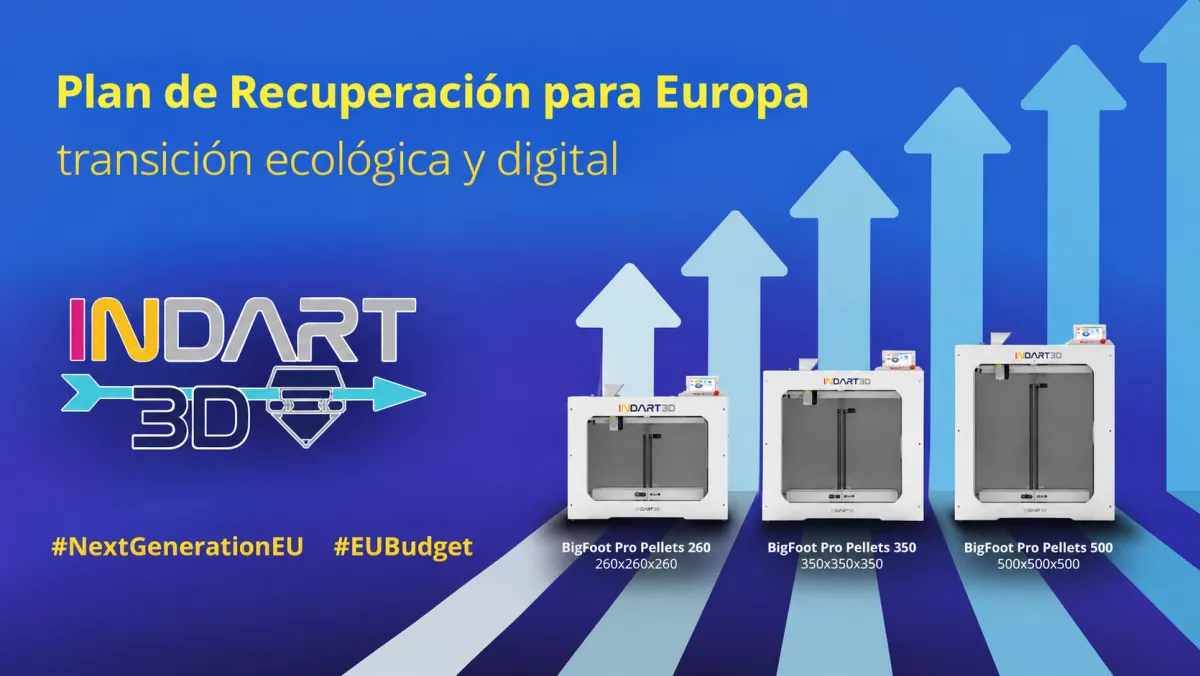
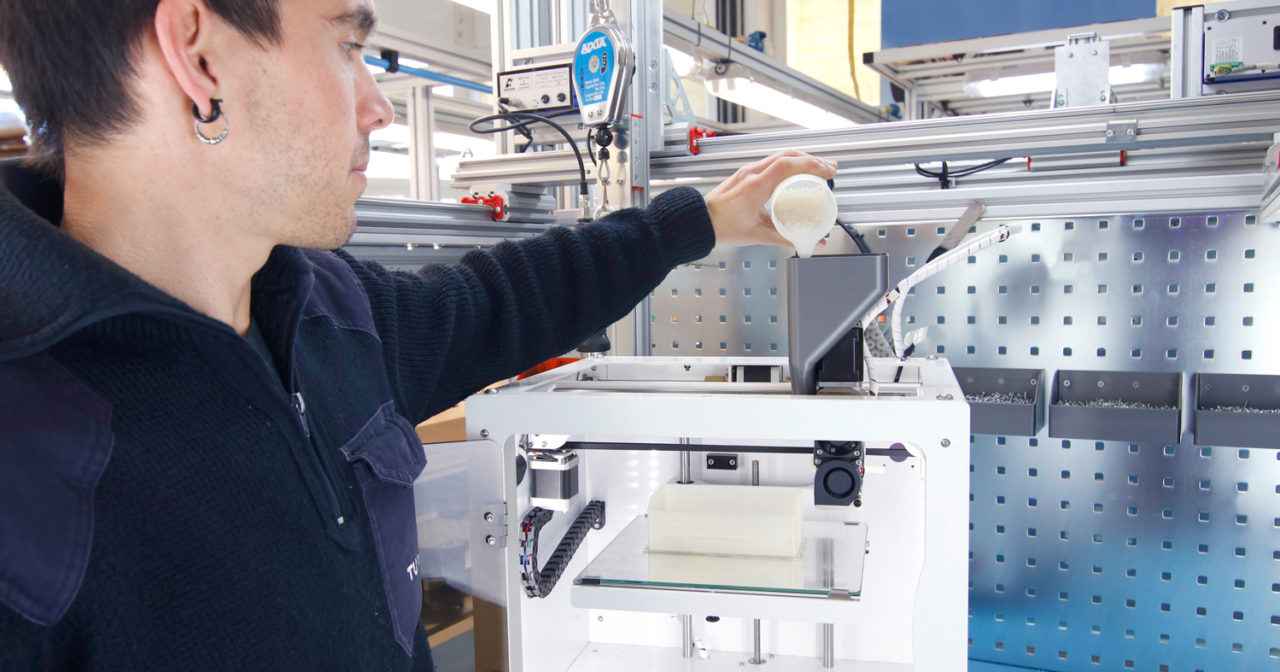
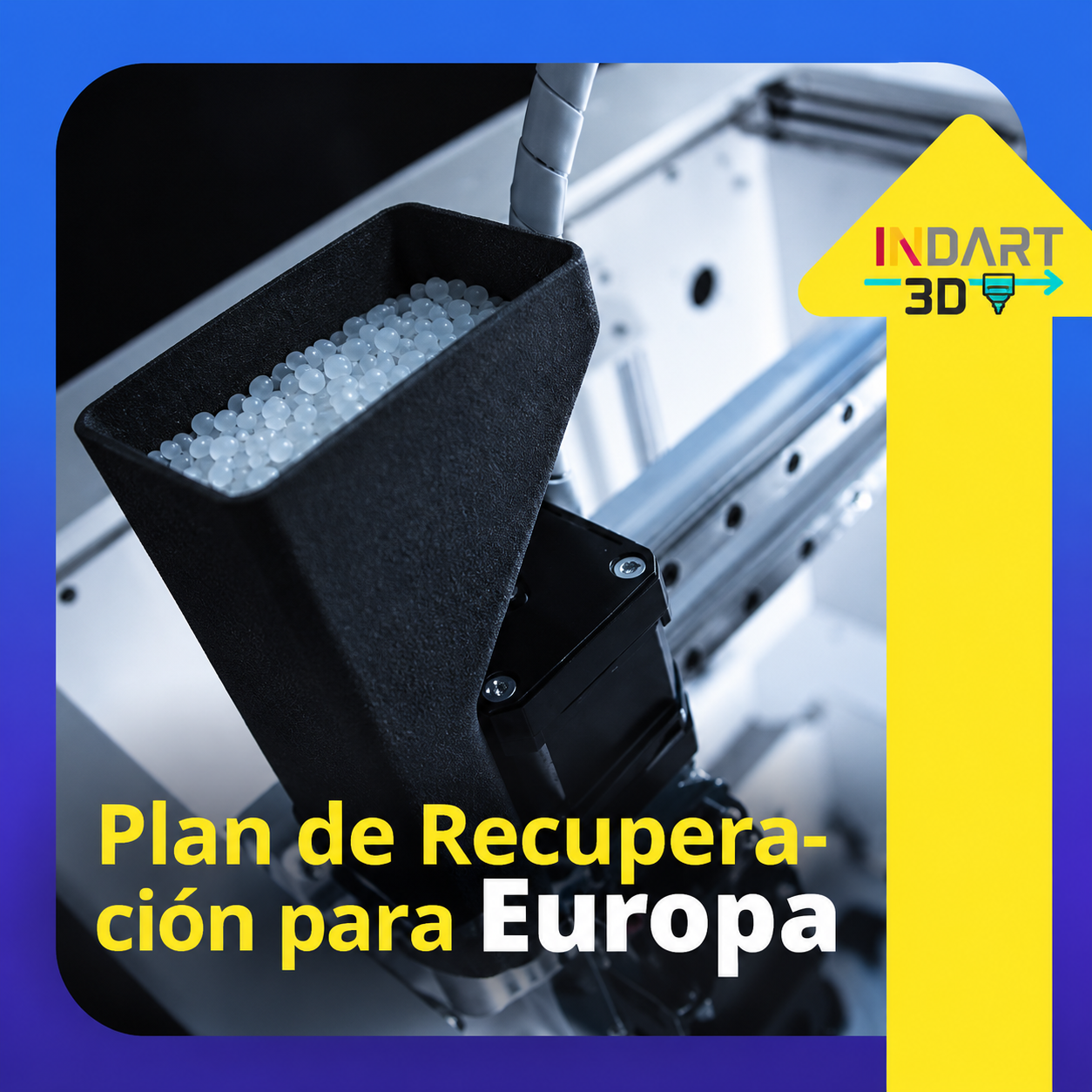
The range of TUMAKER pellet 3D printers is a clear example of this new economy. Machines that can work with materials developed by users themselves. Materials that may come from industrial recycling or even from the development of new formulations.
The use of pellets as a 3D printing material makes it possible to give a new life to materials that are no longer in use and to develop new applications using raw materials discarded by industrial development but which have significant economic and social value.
Thanks to specific research programmes and the use of these pellet printers, applications have already been discovered for recycled materials or materials obtained from coffee waste, agricultural waste or abandoned fishing nets.
"Made in Europe" Technology
The Recovery Plan for Europe aims to establish a series of aid programmes so that innovation and research can help us become the leading force in the global economic transformation. To achieve this objective, the foundation of every project should be based on technological solutions created and developed in Europe.
INDART3D is committed to European products. For this reason, both the development and manufacturing of TUMAKER take place in Spain.
Thanks to this, we have the advantage of being able to respond quickly to market needs. This response includes specific solutions such as the NX Pro DUAL 3D printer with two independent print heads, the previously mentioned Pellet 3D Printer, or the DUAL printer with a dual modular print head, which is expected to be launched in early 2021. A disruptive 3D printer in which users will be able to combine filament print heads with pellet print heads.