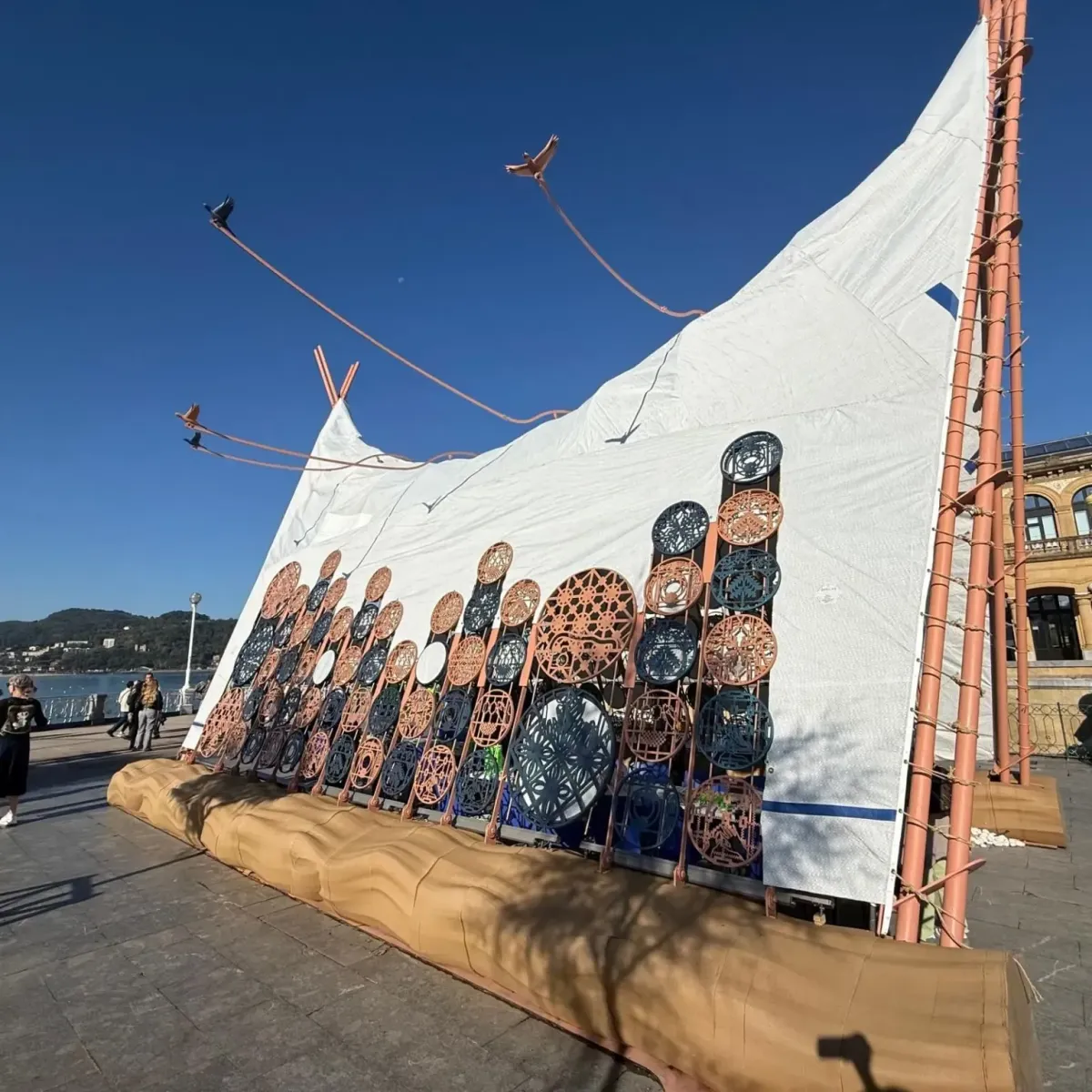
Tumaker at the 2025 Mugak Biennial: large-scale additive manufacturing for a sustainable architectural installation.
When an architectural and cultural project needs to manufacture hundreds of parts using a biodegradable material, within a tight deadline and without compromising precision, pellet 3D printing goes from being an interesting option to becoming one of the most suitable solutions. This is exactly what happened with the Donostia pavilion for the 2025 Basque Country International Architecture Biennial (Mugak), and the Indart3D team, responsible for the design and manufacture of the Tumaker brand, had the opportunity to be part of this project.
The pavilion was installed in Alderdi Eder, opposite Donostia-San Sebastián City Hall, one of the most visible and busiest locations in the city.
Architectural 3D Printing: Embroidery as a Design Concept
The installation, designed by Izaskun Chinchilla Architects, is based on a concept that is both specific and poetic: transforming embroidery, a technique traditionally associated with craftsmanship, into a critical architectural proposal capable of engaging with public space. It is an interpretation that connects a manual craft with centuries of history to the latest manufacturing techniques, and this contrast is precisely part of what makes the project special.
It was a collaborative project in which different companies and organisations contributed their expertise. Indart3D joined the project thanks to the opportunity provided by Cluster Habic and participated by manufacturing all the parts intended for 3D printing. The project was coordinated by Ane Larrieta (COAAT Gipuzkoa), and the Biennial was supported by Eusko Jaurlaritza – Basque Government.
What may have seemed like just another line in a project brief actually involved producing a considerable volume of large parts using a new material, while meeting sustainability requirements that were an integral part of the installation itself.
TUMAKER Pellet Printers for Large-Format Parts
To meet the project’s requirements, we used three machines from our own range, designed and manufactured at our facilities in Irún: the BF Modular, the NX Modular and our 1-metre pellet printer, which became the main machine used for the project and was responsible for producing the largest parts.
This last machine was decisive. It was the printer we used to process the 600 kg of sustainable material required for the installation, something that is only possible with a pellet extrusion system capable of handling large volumes without compromising consistency or finish.
Biodegradable Material for 3D Printing: Olive Stone Pellets
One of the most distinctive aspects of the project was the material selected. Smart Materials 3D’s Eco OLIVE Pellets range was used, a biodegradable and environmentally friendly material developed from olive stones. In addition to being technically compatible with our pellet printers, the material was directly aligned with the project’s values of sustainability and circular economy.
Working with a biodegradable, plant-based material at this scale also demonstrates how far pellet 3D printing can go today when combined with materials designed from the outset to minimise their environmental impact.
Industrial Additive Manufacturing Production: One Month in Irún
Manufacturing all the parts required approximately one full month of production, during which more than 600 kg of material were printed. The entire process, from the first gram of pellets to the final finished part, was carried out entirely at our facilities in Irún.
A workload of this scale requires not only machines designed for continuous production, but also strict process control to ensure that all parts maintain the quality and tolerances required for subsequent assembly.
3D-Printed Parts in a Public-Space Architectural Installation
Once manufactured, the parts were transported to Donostia, where they were assembled in Alderdi Eder. The installation remained on display there for several weeks and became the setting for various activities and workshops organised as part of the exhibition itself. During some of these workshops, members of the public were able to interact directly with the printed parts, completing the connection between technical manufacturing and public experience.
Pellet 3D Printing as a Success Story in Industrial Additive Manufacturing
The Mugak 2025 Biennial is a good example of something we are seeing increasingly often at Tumaker: projects that do not simply require “a 3D printer”, but rather a manufacturing solution capable of responding to a new material, demanding production volumes and a specific deadline, all at the same time.
Our participation in this project demonstrates that pellet 3D printing, when combined with machines designed for industrial production and sustainable materials such as olive stone pellets, can move beyond the laboratory or workshop and become the technology that makes a real architectural installation possible — one that is visible and used by thousands of people in a public space.
A project like this cannot be achieved alone. We would also like to recognise the opportunity provided by Cluster Habic, the collaboration with Smart Materials 3D on materials, the vision of the Izaskun Chinchilla Architects team, the coordination of Ane Larrieta (COAAT Gipuzkoa), and the support provided to the Biennial by Eusko Jaurlaritza – Basque Government.