One Step Further in Research. TUMAKER NX Pro Pellets at the University of Zaragoza
One Step Further in Research. TUMAKER NX Pro Pellets at the University of Zaragoza
Research and technological innovation have always gone hand in hand. One drives the other and vice versa.
Over time, it has been demonstrated that the arrival of 3D printing has led to significant growth in research processes. The establishment of this innovative technology has brought a powerful boost to the sector, and more specifically to the field of biological engineering.
The production and customisation possibilities offered by 3D technology streamline processes while expanding the areas in which it can be applied. But innovation does not end there. The phenomenon that has taken scientific research to the next level has been pellet 3D printing. Until the arrival of pellets, 3D printing was limited to materials available in filament form. This created insurmountable obstacles in numerous situations. Pellet 3D printing removes these barriers, making it possible to manufacture using new materials or certified and approved materials. As a result, a 3D printer can be useful across a wide range of sectors, making faster manufacturing, greater productivity and a significant reduction in costs a reality.
These benefits are already being experienced by the University of Zaragoza. The Multiscale in Mechanical and Biological Engineering Group (M2BE) at the Aragón Institute for Engineering Research (I3A) has made the transition to pellet 3D printing to improve the development of its research.
The Aragón Institute for Engineering Research (I3A) Is Already Working with Pellet 3D Technology
The Multiscale in Mechanical and Biological Engineering Group (M2BE) at the Aragón Institute for Engineering Research (I3A), affiliated with the University of Zaragoza, has recently acquired the TUMAKER NX Pro Pellets printer.
The M2BE group mainly focuses its activities on the development of new multiscale numerical methodologies and technologies in the fields of Mechanical and Biological Engineering. Its commitment to innovation in mechanobiology research aligns perfectly with TUMAKER’s commitment to this sector.
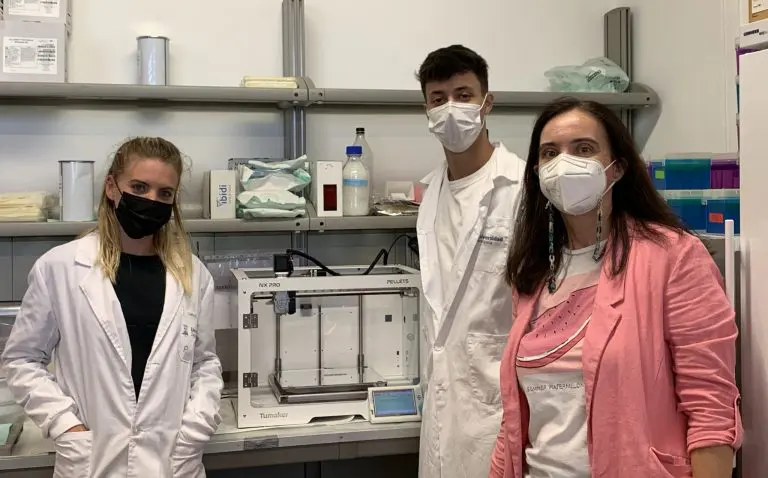
Pilar Alamán-Díez (DGA pre-doctoral researcher), Jorge Campo Teruel (Biomedical Engineering undergraduate student (UC3M) on an internship) and Mª Ángeles Pérez Ansón (University Professor).
Some of the research areas this group is currently working on include: mechanobiology of tumour metastasis, cellular mechano-chemo-biology, tissue engineering and mechanobiology of bone regeneration, design of customised prostheses and implants, and biomechanical modelling of pulmonary fibrosis.
The acquisition of the TUMAKER NX Pro Pellets was motivated by research related to the production of biodegradable scaffolds. These are cylindrical scaffold models with a diameter of 7 mm and a height of 2 mm. These parts are intended to achieve better regeneration of the bone in which they are implanted. In addition, they aim to preserve the mechanical properties of the bone tissue while the scaffolds are degraded and absorbed by the body’s own fluids. The 3D-printed scaffolds are composed of a mixture of two biocompatible and biodegradable polymers: polycaprolactone (PCL) and poly(lactic-co-glycolic acid) (PLGA), at 50% by weight (1:1 composition). The resulting material has optimal properties for tissue engineering applications.
One aspect that the members of the University of Zaragoza themselves highlight about TUMAKER’s pellet technology is its degree of customisation. This characteristic of TUMAKER 3D printing sets it apart from previous techniques. Furthermore, in the case of the M2BE group, this will make it possible to design scaffolds with specific geometries for each treatment.
Comparison of the TUMAKER NX Pro Pellets with the Printer Previously Used by the M2BE Group
The printer previously available to the group was much less complex and had been developed by the group itself. The filament was produced using a screw and an Arduino board, and was then fed into a standard FDM printer to carry out the printing process.
As the members of the research group explain, all this non-automated work significantly slowed down the analysis process. Switching to this new printer streamlines the entire scaffold development process and, above all, reduces process variability. Producing the filament and using two separate devices to achieve the desired print involved a loss of time that has disappeared with the new TUMAKER NX Pro Pellets.
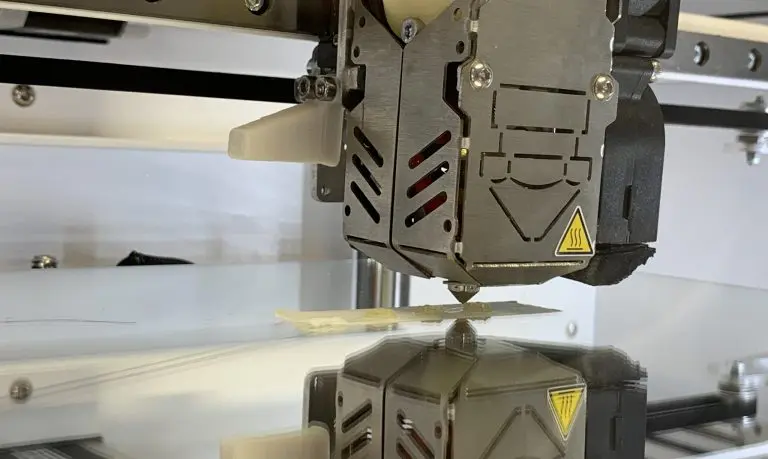
Likewise, the pellet printing method provides greater versatility when manufacturing scaffolds made from specific polymer blends for different functions. The wide range of possibilities opened up by the world of pellets represents a major advancement for the research sector. Applications that were previously unfeasible become much more accessible. As a result, the Aragón Institute for Engineering Research, affiliated with the University of Zaragoza, is already planning to use pellet printing in the development of further projects involving (bio)materials.
The Importance of Research for TUMAKER
The fact that an institution such as the University of Zaragoza is choosing TUMAKER technology reinforces our understanding of technological innovation.
The research sector benefits from innovative contributions designed to facilitate its work. At the same time, research itself generates new challenges that can be addressed through technological innovation. This connection is vital for mutual progress and for advancing as a society. For this reason, at TUMAKER we consider it essential to support the research sector.
The use of the TUMAKER NX Pro Pellets printer by the Aragón Institute for Engineering Research demonstrates the benefits of 3D printing in the sector. In fact, this collaboration has many similarities with the existing relationship between TUMAKER and the University of Vigo.
The New Materials Group (FA3) at UVigo uses the same printer for projects focused on the manufacture of scaffolds and biocompatible devices for applications in tissue engineering. Another example of how the sector can be strengthened through 3D printing.
Ultimately, and fortunately, the world of research continues to grow. And at TUMAKER, we could not be prouder that this growth is happening by working together. Not for us, but for EVERYONE.
Discover our technological solutions at: www.tumaker.com