

Pellet 3D Printing: Bridging Material Development and Industrial Manufacturing
Developing new polymer formulations involves much more than achieving specific material properties. It is also necessary to study processability, validate behaviour and assess their potential before moving towards industrial-scale manufacturing processes.
This is precisely one of the challenges faced by E.V.A Biosystems, a UK cleantech company developing intelligent, selectively degradable plastics through the incorporation of biological additives, with the aim of improving the end-of-life outcomes of conventional polymers.
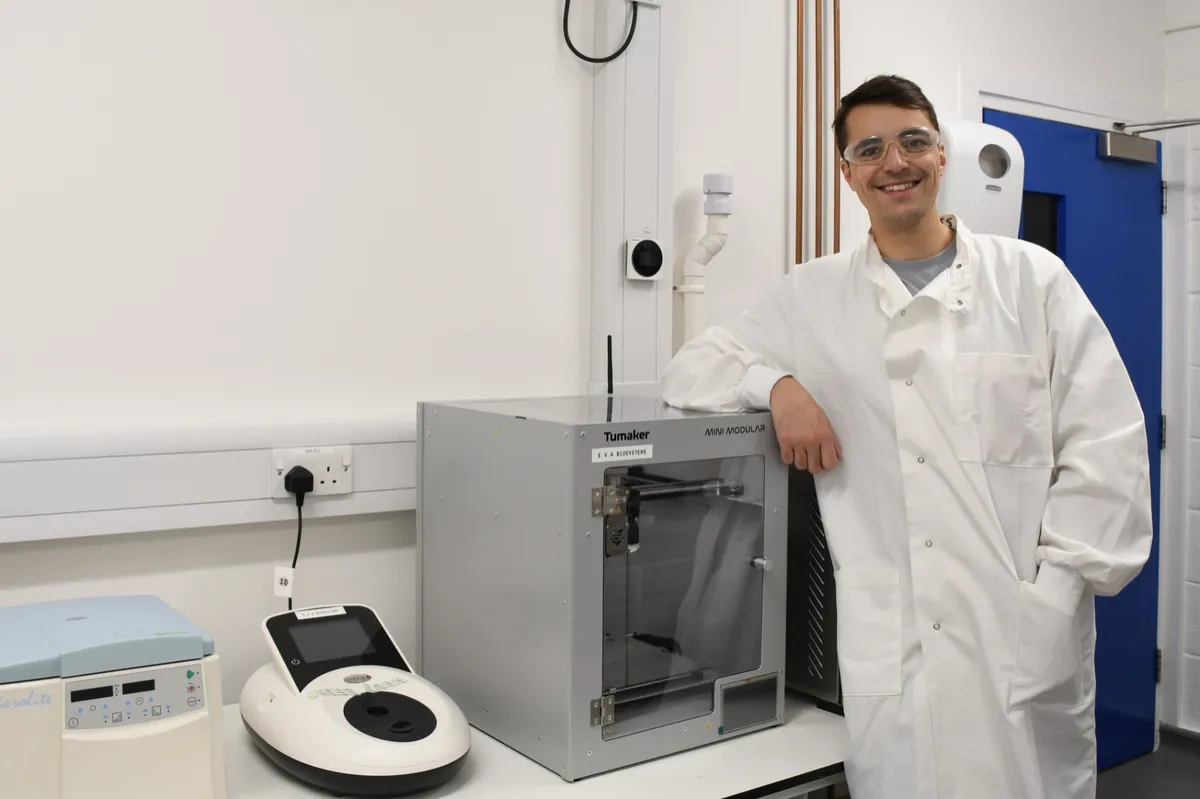
To support its material research and new formulation development activities, E.V.A Biosystems incorporated a Tumaker Mini Modular equipped with direct pellet extrusion, allowing the team to validate new formulations in-house while maintaining a direct connection with the materials and processes subsequently used at industrial scale.
E.V.A Biosystems: New Approaches to Improving Plastic Sustainability
E.V.A Biosystems is developing a new approach to improving the sustainability of plastics through biological additives that can be incorporated into conventional polymers during manufacturing.
Rather than completely replacing existing materials and supply chains, its technology aims to provide practical and scalable solutions that can work with plastics already widely used by industry.
The goal is to enable controlled degradation under specific environmental conditions while maintaining the performance, cost and processability of conventional polymers.
The company currently works with materials commonly used in packaging and industrial applications, including polypropylene (PP) and PET.
The Challenge: Validating New Materials Efficiently
One of the main challenges for companies developing new materials lies in the transition between laboratory-scale formulation and subsequent processing using industrial technologies.
Before moving to larger-scale manufacturing processes, teams need to understand how new formulations behave during processing, carry out different iterations and obtain results that support decisions about the next stages of development.
E.V.A Biosystems collaborates with external manufacturing partners, including the National Manufacturing Institute Scotland (NMIS), where injection moulding forms part of its validation process.
To complement this work, the team needed a flexible tool that would allow it to process in-house the same pellet materials subsequently used in other industrial processes, reducing dependence on external resources during the early stages of development.
Why Direct Pellet 3D Printing?
For E.V.A Biosystems, working directly with pellets offers a particularly important advantage.
Unlike filament-based 3D printing, pellet 3D printing makes it possible to work directly with polymer granules without first converting each experimental formulation into filament.
This allows materials to be used in a format much closer to that employed later in other manufacturing processes. In addition, using the same materials across different development workflows provides a more consistent basis for comparing additive manufacturing results with those obtained through processes such as injection moulding.
For companies developing new formulations, this capability turns pellet 3D printing into more than a technology for producing parts: it becomes a tool for researching, iterating and validating materials throughout development.
“Pellet extrusion is useful for us because it allows us to work with polymer materials in a format that is closer to industrial processing than filament-based printing.”
“Being able to use the same materials across both workstreams gives us a more consistent basis for comparison and helps us generate more meaningful results.”
The Solution: Tumaker Mini Modular for Direct Pellet 3D Printing
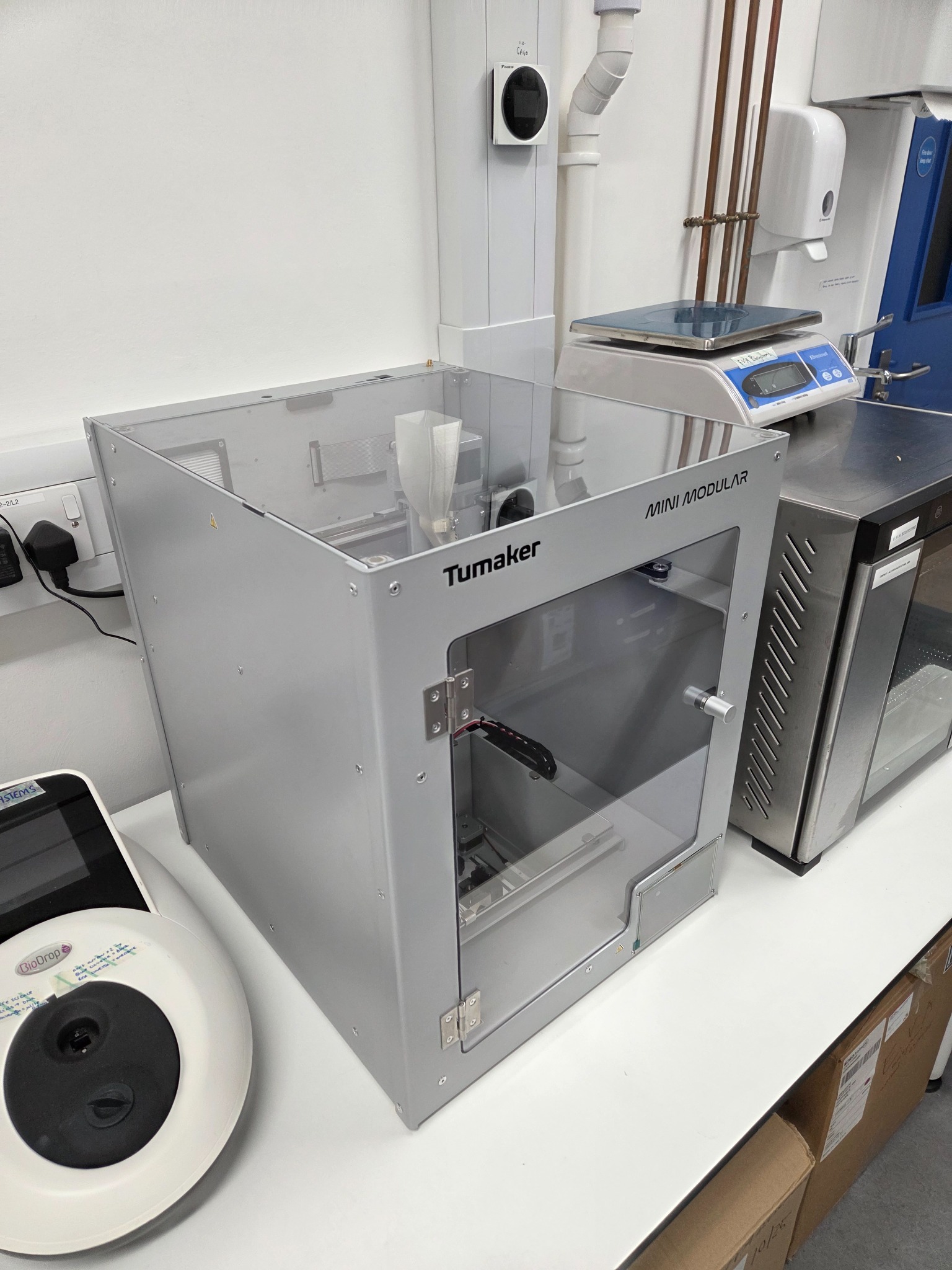
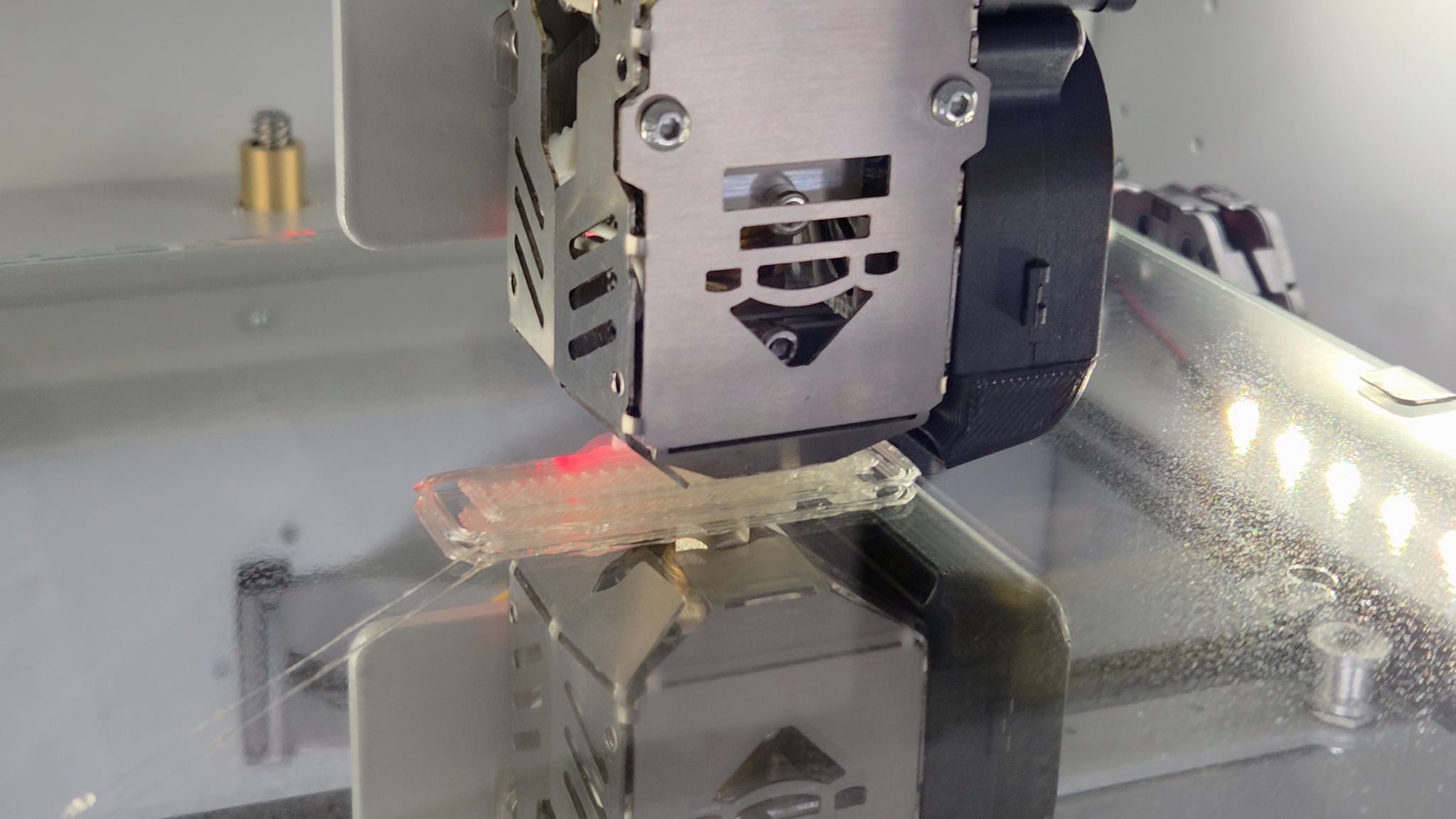
To bring this capability into its laboratory, E.V.A Biosystems selected a Tumaker Mini Modular equipped with a pellet extrusion system for direct 3D printing from polymer granules.
Developed and manufactured by Indart3D, Tumaker technology enables teams to work directly with pellet materials and produce test specimens and components in-house to evaluate new formulations throughout the different stages of development.
Its compact format, modular architecture and ability to process pellets make the Mini Modular particularly well suited to material research and R&D environments where frequent testing of different formulations is required.
This enables E.V.A Biosystems to carry out an initial manufacturing and evaluation stage within its own facilities before progressing to larger-scale external processes.
Accelerating Research and Development of New Materials
Since incorporating the system, E.V.A Biosystems has been able to accelerate its development workflow.
The ability to manufacture small-scale test parts in-house allows the team to evaluate new ideas earlier, iterate more quickly and make decisions without immediately relying on external manufacturing processes.
This bridge between the laboratory and more industrially representative manufacturing processes is one of the most interesting aspects of the application.
3D printing does not replace subsequent industrial validation or manufacturing processes. Instead, it enables early iterations to be carried out much more efficiently, allowing the team to move to the next stages with more information about the behaviour of each formulation.
“The printer has helped us make our development process faster and more flexible.”
“A useful bridge between lab-scale material development and more industrially relevant processing.”
Key Benefits Achieved
Integrating the Tumaker Mini Modular into E.V.A Biosystems' workflow has delivered four main advantages.
Faster iteration cycles. The team can manufacture and evaluate test specimens and components in-house, reducing development times and accelerating decision-making.
Greater consistency between processes. Working with pellet material helps maintain continuity between additive manufacturing tests and other industrial processes used later.
Greater development flexibility. New formulations can be evaluated quickly before committing resources to larger-scale manufacturing campaigns.
Reliability in an R&D environment. When the primary objective is material research, a stable process allows researchers to focus on material behaviour and the formulations themselves.
“The main advantages have been speed, consistency and reliability.”
A Tool for Research and Validation of New Materials
E.V.A Biosystems operates at the intersection of advanced materials, manufacturing, life sciences and sustainable technologies.
In this context, having tools that accelerate experimentation and connect early formulations with more representative manufacturing processes is particularly valuable.
Combining pellet-based additive manufacturing with conventional industrial processes can shorten development cycles while maintaining a direct relationship between the material under investigation and the technologies with which it will subsequently be processed.
For E.V.A Biosystems, the Tumaker Mini Modular has therefore become a tool within this development workflow, helping the team move more quickly from experimental formulations towards industrially relevant validation.
Equipment Used
Machine | Tumaker Mini Modular |
Extrusion system | Pellet |
Application | Development and validation of sustainable polymer formulations |
Materials | PP, PET and other polymers related to packaging applications |
Sector | Sustainable materials, Cleantech, Advanced Manufacturing and Life Sciences |