
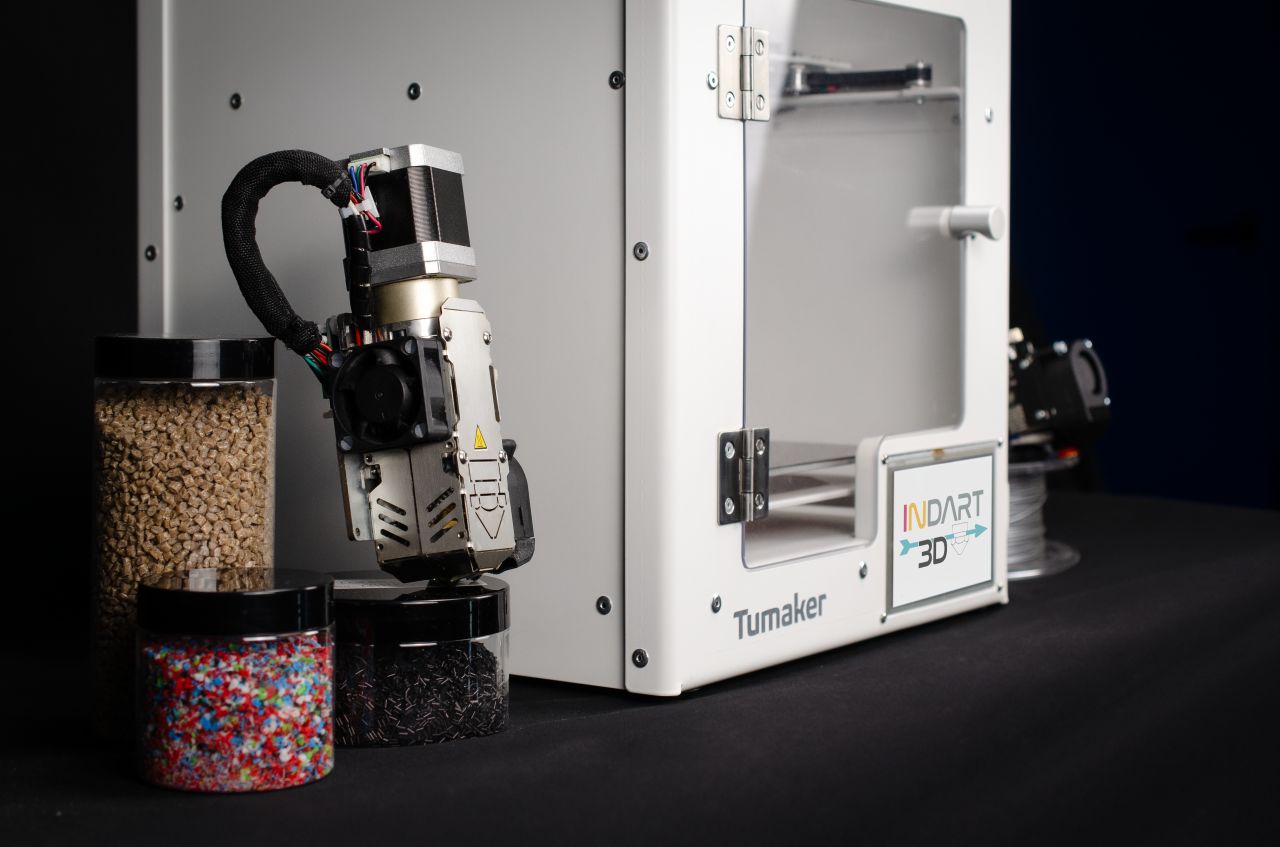
Circular economy manufacturing is not a new concept, but its application in advanced manufacturing environments remains largely unexplored territory. In university labs and research centers, where manufacturing processes are often material- and energy-intensive, the question of how to close the resource loop is becoming increasingly relevant — both out of conviction and because funding bodies and evaluation agencies now demand it.
Additive manufacturing, and pellet 3D printing technology in particular, is emerging as one of the tools most aligned with that goal. Not because it is perfect, but because its technological architecture fits naturally with several of the core principles of the circular economy.
What does closing the material loop mean in manufacturing
The circular economy starts from a simple premise: the waste from one process should become the raw material for the next. Applied to manufacturing, this means rethinking how materials are selected, how they are processed, what happens to surplus material, and whether finished parts can be recovered and fed back into the production cycle at the end of their useful life.
In conventional manufacturing processes — machining, injection molding, thermoforming — closing that loop is complex. Waste generation is structural, processed materials are often not recoverable in their original form, and the infrastructure needed for in-house recycling is costly and poorly suited to a lab environment.
Sustainable additive manufacturing changes part of that equation. By building parts layer by layer, it deposits only the material needed, significantly reducing the waste generated during the process. But beyond this general advantage, pellet technology introduces a set of specific features that make it especially well aligned with circular economy principles.
Why pellet technology supports circular economy manufacturing
Access to raw material in its most primary form. Pellets are the form in which the chemical industry sells most polymers before any transformation. Working directly with pellets eliminates the filament-extrusion step — a process that consumes energy, can partially degrade the material, and introduces additives that in some cases make later recovery harder. Fewer intermediate transformations means a shorter, cleaner cycle.
Compatibility with renewable and waste-derived materials. Pellet technology can process a much wider range of materials than conventional filament systems. This includes plant-based biopolymers such as PLA or PHA, composite materials with natural or waste-derived fillers — agricultural fibers, nutshell powders, byproducts of the agri-food industry — and polymers recovered from industrial processes. In all these cases, additive manufacturing acts as a valorization vector: it turns waste or a byproduct into raw material for precision manufacturing.
At Indart3D, the company behind the manufacturing of Tumaker printers, we recently validated materials such as JECTO, developed by Nuterials — a 100% biobased, biodegradable biocomposite formulated with natural polymers and walnut shell. Developments like this show how pellet 3D printing makes it easier to evaluate new sustainable 3D printing materials without first having to convert them into filament.
Recovery and reuse of surplus material. Unlike filament, which once partially melted or exposed to humidity can degrade and become unusable, surplus unprocessed pellets can be recovered and fed back into the process without significant loss of properties. In a lab setting, this translates into more efficient material management and less waste generated per experiment.
Potential to reprocess printed parts. Some thermoplastic materials processed through pellet-based additive manufacturing can be shredded and reprocessed as second-generation pellets, closing the loop within the lab itself. This possibility, still under active research for many formulations, opens a path to applying circular economy manufacturing in full — from raw material all the way to part recovery at end of life.
Scalability without reformulation. The same pellets used in a lab printer can be used in larger-scale production systems without needing to adapt the material. This makes it easier to transfer results from academic settings to industry, reducing the waste associated with optimization and scale-up processes.
Research directions at the intersection of additive manufacturing and the circular economy
Growing interest from the scientific community in this intersection is reflected in a rising number of publications that approach additive manufacturing from a life-cycle and circular economy perspective. Some of the most active research directions today include:
Development of composite materials with waste-derived fillers. Formulating polymer matrices loaded with industrial or agricultural byproducts is one of the most active areas. The goal is twofold: improve the mechanical or functional properties of the base material, and incorporate a waste-derived fraction that reduces the environmental footprint of the resulting composite.
Biopolymers processable by additive manufacturing. Work with biological, biodegradable polymers is another growing area, especially in biomedical, pharmaceutical, and packaging applications. Pellet-based additive manufacturing allows these materials to be processed with greater flexibility and less thermal degradation than filament systems, preserving their properties and their ability to compost or biodegrade at end of cycle.
Life cycle assessment of additive manufacturing processes. A third, more cross-cutting line of research evaluates the real environmental impact of additive manufacturing processes using life cycle assessment (LCA) methodologies. These studies help identify the critical points in the process and establish comparisons with conventional processes.
Recyclability of printed materials. Finally, several research groups are investigating the technical feasibility of recycling parts made by fused deposition, assessing how reprocessing affects the mechanical, thermal, and rheological properties of the material and how many cycles it can withstand before degrading significantly.
Indart3D: from research to real-world applications of circular economy manufacturing in industrial 3D printing
These circular economy principles aren’t limited to theory — they’re already present in real projects developed with pellet extrusion technology. Indart3D is the industrial additive manufacturing brand behind Tumaker printers, and through it we work closely with material manufacturers, universities and technology centers looking to validate new compounds and take them from the lab to applications with real-world impact.
That collaboration takes shape in very different projects, but with a common thread: using pellet 3D printing as a testbed for materials that don’t yet have an established place in industry. This is the case with the biocomposites developed alongside Smart Materials 3D for the Euskadi Mugak International Architecture Biennial, the trials with Nuterials’ biobased formulations, and the technical polymer characterization work carried out with LATI3Dlab.
Together, these cases point to a pattern that keeps repeating: pellet technology doesn’t just manufacture parts — it acts as a bridge between those developing sustainable materials and the industries that could adopt them at scale.
Tumaker: developing and manufacturing professional 3D printers for Industry 4.0
There is something particularly valuable about approaching the circular economy from an academic setting: research groups can design their processes from scratch, without the inertia and constraints that shape established industry. That makes them a privileged space for experimenting with more circular manufacturing models and generating the knowledge industry needs to make that transition.
Pellet-based additive manufacturing, thanks to its flexibility and compatibility with next-generation materials, is well positioned to support that process. Not as a single solution, but as one more piece of a manufacturing ecosystem that is learning to close its own loops.
If you’re developing a research line in advanced materials, circular economy, or sustainable manufacturing and want to explore how to integrate pellet technology into your workflow, get in touch with our team. We’ll look at the possibilities together.
